

Dosya:A spiral home to exploding stars.jpg - Vikipedi
İçeriğe atla
Ana menü
Gezinti
  • Anasayfa
  • Hakkımızda
  • İçindekiler
  • Rastgele madde
  • Seçkin içerik
  • Yakınımdakiler
Katılım
  • Deneme tahtası
  • Köy çeşmesi
  • Son değişiklikler
  • Dosya yükle
  • Topluluk portalı
  • Wikimedia dükkânı
  • Yardım
  • Özel sayfalar
Vikipedi Özgür Ansiklopedi
Ara
  • Bağış yapın
  • Hesap oluştur
  • Oturum aç
  • Bağış yapın
  • Hesap oluştur
  • Oturum aç

Dosya:A spiral home to exploding stars.jpg

Sayfa içeriği diğer dillerde desteklenmemektedir.
  • Dosya
  • Tartışma
  • Oku
  • Wikimedia Commons üzerinde gör
  • Yerel açıklama ekle
  • Yerel açıklama kaynağı ekle
Araçlar
Eylemler
  • Oku
  • Wikimedia Commons üzerinde gör
  • Yerel açıklama ekle
  • Yerel açıklama kaynağı ekle
Genel
  • Sayfaya bağlantılar
  • Basılmaya uygun görünüm
  • Sayfa bilgisi
  • Kısaltılmış URL'yi al
  • Karekodu indir
Diğer projelerde
Görünüm
Vikipedi, özgür ansiklopedi
  • Dosya
  • Dosya geçmişi
  • Dosya kullanımı
  • Küresel dosya kullanımı
  • Üstveri
Dosya:A spiral home to exploding stars.jpg
Bu önizlemenin boyutu: 655 × 599 piksel. Diğer çözünürlükler: 262 × 240 piksel | 525 × 480 piksel | 839 × 768 piksel | 1.119 × 1.024 piksel | 2.134 × 1.953 piksel.
Tam çözünürlük ((2.134 × 1.953 piksel, dosya boyutu: 2,29 MB, MIME tipi: image/jpeg))
Bu dosya Wikimedia Commons'ta bulunmaktadır. Dosyanın açıklaması aşağıda gösterilmiştir.
Commons, serbest/özgür telifli medya dosyalarının bulundurulduğu depodur. Siz de yardım edebilirsiniz.
Bu dosya Wikimedia Commons'ta bulunmaktadır.

Özet

AçıklamaA spiral home to exploding stars.jpg
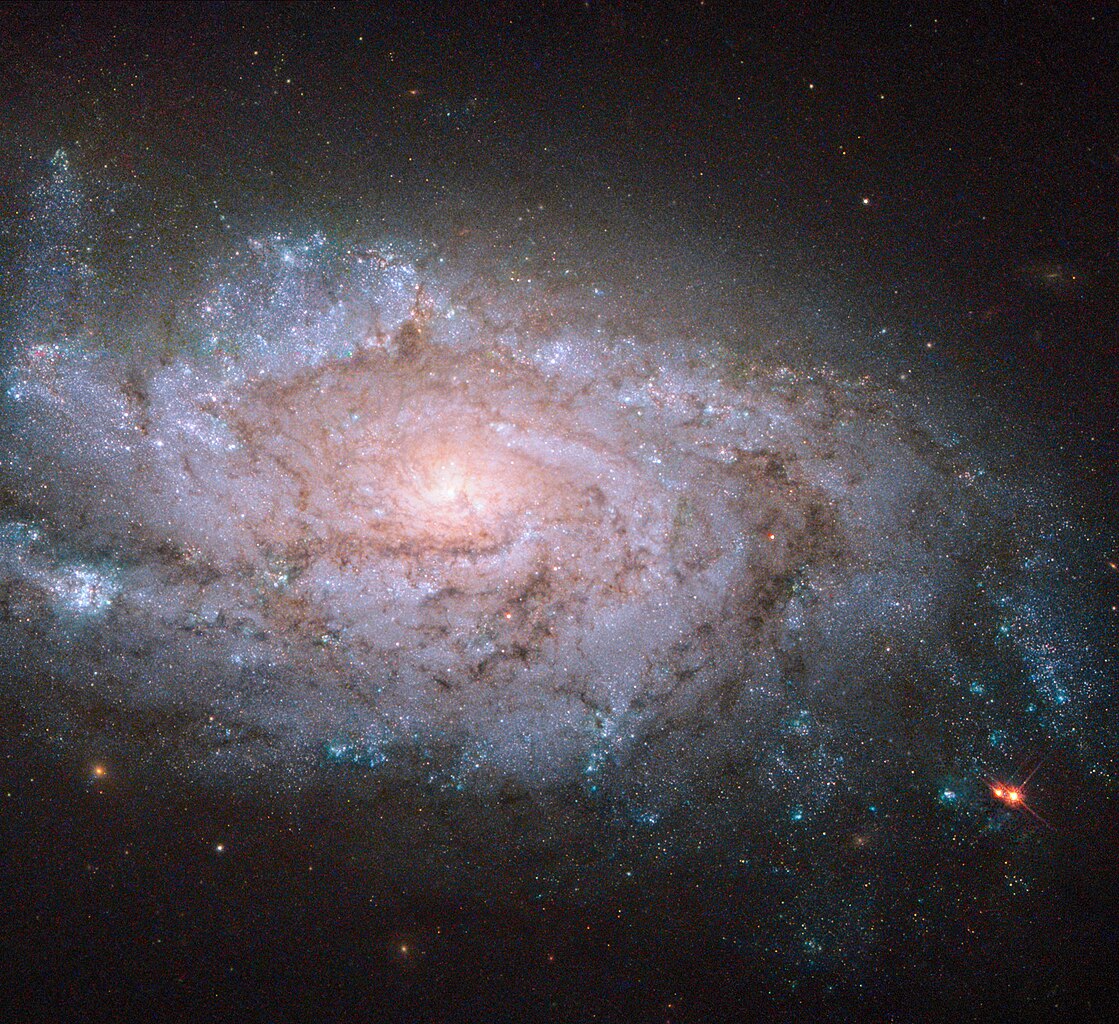
English: In this new Hubble image, we can see an almost face-on view of the galaxy NGC 1084. At first glance, this galaxy is pretty unoriginal. Like the majority of galaxies that we observe it is a spiral galaxy, and, as with about half of all spirals, it has no bar running through its loosely wound arms. However, although it may seem unremarkable on paper, NGC 1084 is actually a near-perfect example of this type of galaxy — and Hubble has a near-perfect view of it.

NGC 1084 has hosted several violent events known as supernovae — explosions that occur when massive stars, many times more massive than the Sun, approach their twilight years. As the fusion processes in their cores run out of fuel and come to an end, these stellar giants collapse, blowing off their outer layers in a violent explosion. Supernovae can often briefly outshine an entire galaxy, before then fading away over several weeks or months. Although directly observing one of these explosions is hard to do, in galaxies like NGC 1084 astronomers can find and study the remnants left behind.

Astronomers have noted five supernova explosions within NGC 1084 over the past half century. These remnants are named after the year in which they took place — 1963P, 1996an, 1998dl, 2009H, and 2012ec.

The most recent explosion, 2012ec, was detected at the end of NGC 1084’s top right arm in August 2012. It is not visible here as these images were taken in 2001, some eleven years before this supernova exploded. Astronomers at Queen's University Belfast have managed to use these "before" images to directly identify the star that exploded. It appears to be a red supergiant some 10 to 20 times more massive than the Sun, and quite similar to the well-known star Betelguese in Orion.

A version of this image was entered into the Hubble's Hidden Treasures image processing competition by Flickr user Brian Campbell (Sinickel).
Tarih 31 Mart 2014, 10:00:00
Kaynak http://www.spacetelescope.org/images/potw1413a/
Yazar

NASA, ESA, and S. Smartt (Queen's University Belfast)

Acknowledgement: Brian Campbell

Lisanslama


atıf
atıf
ESA/Hubble images, videos and web texts are released by the ESA under the Creative Commons Attribution 4.0 International license and may on a non-exclusive basis be reproduced without fee provided they are clearly and visibly credited. Detailed conditions are below; see the ESA copyright statement for full information. For images created by NASA or on the hubblesite.org website, or for ESA/Hubble images on the esahubble.org site before 2009, use the {{PD-Hubble}} tag.
Conditions:
  • The full image or footage credit must be presented in a clear and readable manner to all users, with the wording unaltered (for example: "ESA/Hubble"). Web texts should be credited to ESA/Hubble (except when used by media). The credit should not be hidden or disassociated from the image footage. Links should be active if the credit is online. See the usage rights Q&A section on the ESA copyright page for guidance.
  • ESA/Hubble materials may not be used to state or imply the endorsement by ESA/Hubble or any ESA/Hubble employee of a commercial product or service.
  • ESA/Hubble requests a copy of the product sent to them to be indexed in their archive.
  • If an image shows an identifiable person, using that image for commercial purposes may infringe that person's right of privacy, and separate permission should be obtained from the individual.
  • If images or visuals are changed significantly from the original work (apart from resizing, cropping), we suggest that the changes are mentioned after the credit line. For example "Original image by ESA/Hubble (M. Kornmesser), warping and recolouring by NN".

Notes:

  • Note that this general permission does not extend to the use of ESA/Hubble's logo, which shall remain protected and may not be used or reproduced without prior and individual written consent of ESA/Hubble.
  • Also note that music, scientific papers and code on the esahubble.org site are not released under this license and can not be used for non-ESA/Hubble products.
  • By reproducing ESA/Hubble material, in part or in full, the user acknowledges the terms on which such use is permitted.
w:tr:Creative Commons
atıf
Bu dosya Creative Commons Atıf 4.0 Uluslararası lisansı altında lisanslanmıştır.
Atıf:
ESA/Hubble
Şu seçeneklerde özgürsünüz:
  • paylaşım – eser paylaşımı, dağıtımı ve iletimi
  • içeriği değiştirip uyarlama – eser adaptasyonu
Aşağıdaki koşullar geçerli olacaktır:
  • atıf – Esere yazar veya lisans sahibi tarafından belirtilen (ancak sizi ya da eseri kullanımınızı desteklediklerini ileri sürmeyecek bir) şekilde atıfta bulunmalısınız.
https://creativecommons.org/licenses/by/4.0CC BY 4.0 Creative Commons Attribution 4.0 truetrue

Altyazılar

Bu dosyanın temsil ettiği şeyin tek satırlık açıklamasını ekleyin.

Bu dosyada gösterilen öğeler

betimlenen

telif hakkı durumu

telif hakkı alınmış

telif hakkı lisansı

Creative Commons Atıf 4.0 Uluslararası

kuruluşu

31 Mart 2014

ortam türü

image/jpeg

sağlama toplamı

d11916feadcc79a48535fb3824943016bb0d3463

tespit yöntemi: SHA-1

dosya boyutu

2.397.245 bayt

boyu

1.953 piksel

genişliği

2.134 piksel

Dosya geçmişi

Dosyanın herhangi bir zamandaki hâli için ilgili tarih/saat kısmına tıklayın.

Tarih/SaatKüçük resimBoyutlarKullanıcıYorum
güncel23.09, 31 Mart 201423.09, 31 Mart 2014 tarihindeki sürümün küçültülmüş hâli2.134 × 1.953 (2,29 MB)JmencisomUser created page with UploadWizard

Dosya kullanımı

Bu görüntü dosyasına bağlantısı olan sayfalar:

  • Sarmal galaksi

Küresel dosya kullanımı

Aşağıdaki diğer vikiler bu dosyayı kullanmaktadır:

  • ar.wikipedia.org üzerinde kullanımı
    • NGC 1084
  • ca.wikipedia.org üzerinde kullanımı
    • Galàxia espiral
  • de.wikipedia.org üzerinde kullanımı
    • NGC 1084
  • el.wikipedia.org üzerinde kullanımı
    • NGC 1084
  • en.wikipedia.org üzerinde kullanımı
    • Spiral galaxy
    • Herschel 400 Catalogue
    • NGC 1084
  • en.wikiquote.org üzerinde kullanımı
    • Milky Way
  • eu.wikipedia.org üzerinde kullanımı
    • Galaxia
  • fa.wikipedia.org üzerinde kullanımı
    • ان‌جی‌سی ۱۰۸۴
  • fr.wikipedia.org üzerinde kullanımı
    • NGC 1084
  • it.wikipedia.org üzerinde kullanımı
    • Gruppo di NGC 1052
    • Catalogo Herschel 400
    • NGC 1084
  • ko.wikipedia.org üzerinde kullanımı
    • 나선 은하
  • lb.wikipedia.org üzerinde kullanımı
    • NGC 1084
  • mk.wikipedia.org üzerinde kullanımı
    • Спирална галаксија
  • pl.wikipedia.org üzerinde kullanımı
    • NGC 1084
  • zh.wikipedia.org üzerinde kullanımı
    • 螺旋星系

Üstveri

Bu dosyada, muhtemelen fotoğraf makinesi ya da tarayıcı tarafından eklenmiş ek bilgiler mevcuttur. Eğer dosyada sonradan değişiklik yapıldıysa, bazı bilgiler yeni değişikliğe göre eski kalmış olabilir.

KaynakESA/Hubble
Katkı/SağlayıcıNASA, ESA, and S. Smartt (Queen's University Belfast)Acknowledgement: Brian Campbell
Resim başlığı
  • In this new Hubble image, we can see an almost face-on view of the galaxy NGC 1084. At first glance, this galaxy is pretty unoriginal. Like the majority of galaxies that we observe it is a spiral galaxy, and, as with about half of all spirals, it has no bar running through its loosely wound arms. However, although it may seem unremarkable on paper, NGC 1084 is actually a near-perfect example of this type of galaxy— and Hubble has a near-perfect view of it. NGC 1084 has hosted several violent events known as supernovae — explosions that occur when massive stars, many times more massive than the Sun, approach their twilight years. As the fusion processes in their cores run out of fuel and come to an end, these stellar giants collapse, blowing off their outer layers in a violent explosion. Supernovae can often briefly outshine an entire galaxy, before then fading away over several weeks or months. Although directly observing one of these explosions is hard to do, in galaxies like NGC 1084 astronomerscan find and study the remnants left behind. Astronomers have noted five supernova explosions within NGC 1084 over the past half century. These remnants are named after the year in which they took place — 1963P, 1996an, 1998dl, 2009H, and 2012ec. The most recent explosion, 2012ec, was detected atthe end of NGC 1084’s top right arm in August 2012. It is not visible here as these images were taken in 2001, some eleven years before this supernova exploded. Astronomers at Queen's University Belfast have managed to use these "before" images to directly identify the star that exploded. It appears to be a red supergiant some 10 to 20 times more massive than the Sun, and quite similar to the well-known star Betelguese in Orion. A version of this image was entered into the Hubble's Hidden Treasures image processing competition by Flickr user Brian Campbell (Sinickel).
Kısa başlık
  • A spiral home to exploding stars
Kullanım şartları
  • Creative Commons Attribution 3.0 Unported license
Verinin ilk yaratılma zamanı10.00, 31 Mart 2014
Kullanılan yazılımAdobe Photoshop CS6 (Windows)
Özgün belgenin benzersiz kimliğixmp.did:86F5805E1C25E311A5A4C3FD8C3E8B93
Anahtar kelimelerNGC 1084
İletişim bilgileri

http://www.spacetelescope.org/

Karl-Schwarzschild-Strasse 2

Garching bei München, , D-85748 Germany

"https://tr.wikipedia.org/wiki/Dosya:A_spiral_home_to_exploding_stars.jpg" sayfasından alınmıştır
  • Gizlilik politikası
  • Vikipedi hakkında
  • Sorumluluk reddi
  • Davranış Kuralları
  • Geliştiriciler
  • İstatistikler
  • Çerez politikası
  • Mobil görünüm
  • Wikimedia Foundation
  • Powered by MediaWiki
Dosya:A spiral home to exploding stars.jpg
Konu ekle