


Dosya:Echinococcus Life Cycle.svg

Bu SVG dosyasının PNG önizlemesinin boyutu: 629 × 600 piksel. Diğer çözünürlükler: 252 × 240 piksel | 504 × 480 piksel | 806 × 768 piksel | 1.074 × 1.024 piksel | 2.149 × 2.048 piksel | 1.280 × 1.220 piksel.
Tam çözünürlük (SVG dosyası, sözde 1.280 × 1.220 piksel, dosya boyutu: 643 KB)
 | Bu dosya Wikimedia Commons'ta bulunmaktadır. Dosyanın açıklaması aşağıda gösterilmiştir. Commons, serbest/özgür telifli medya dosyalarının bulundurulduğu depodur. Siz de yardım edebilirsiniz. |

Özet
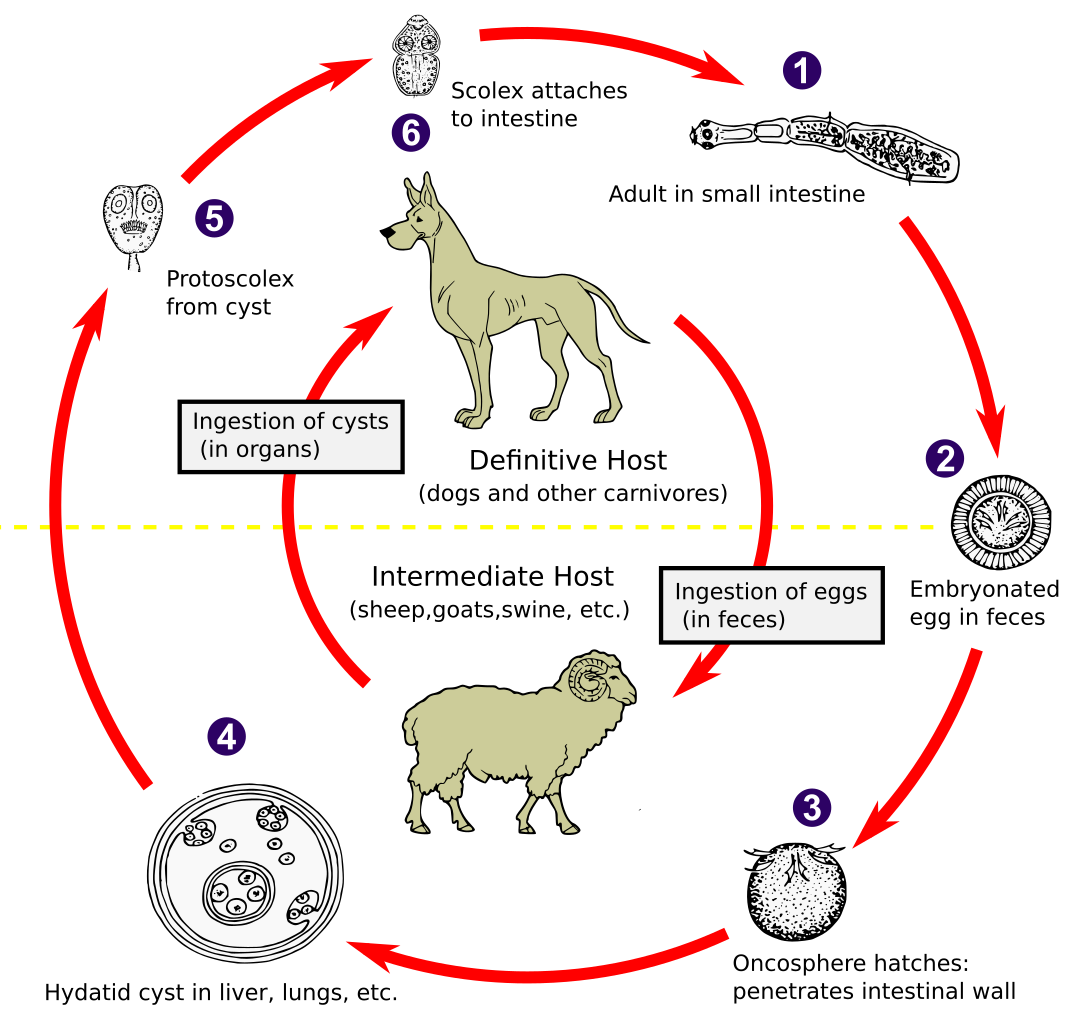
| Açıklama | The adult Echinococcus granulosus (3 to 6 mm long) [1] resides in the small bowel of the definitive hosts (dogs or other carnivores). Gravid proglottids release eggs [2] that are passed in the feces. After ingestion by a suitable intermediate host (under natural conditions: sheep, goat, swine, cattle, horses, camel), the egg hatches in the small bowel and releases an oncosphere [3] that penetrates the intestinal wall and migrates through the circulatory system into various organs, especially the liver and lungs. In these organs, the oncosphere develops into a cyst [4] that enlarges gradually, producing protoscolices and daughter cysts that fill the cyst interior. The definitive host becomes infected by ingesting the cyst-containing organs of the infected intermediate host. After ingestion, the protoscolices [5] evaginate, attach to the intestinal mucosa [6] and develop into adult stages [1] in 32 to 80 days. The same life cycle occurs with E. multilocularis (1.2 to 3.7 mm), with the following differences: the definitive hosts are foxes, and to a lesser extent dogs, cats, coyotes and wolves; the intermediate host are small rodents; and larval growth (in the liver) remains indefinitely in the proliferative stage, resulting in invasion of the surrounding tissues. With E. vogeli (up to 5.6 mm long), the definitive hosts are bush dogs and dogs; the intermediate hosts are rodents; and the larval stage (in the liver, lungs and other organs) develops both externally and internally, resulting in multiple vesicles. E. oligarthrus (up to 2.9 mm long) has a life cycle that involves wild felids as definitive hosts and rodents as intermediate hosts. Humans become infected by ingesting eggs , with resulting release of oncospheres in the intestine and the development of cysts in various organs. Image adapted from original available at the United States Centres for Disease Control Parasitology Identification Laboratory ([1]). |
| Tarih | |
| Kaynak |
Bu dosya şu kaynaktan türetilmiştir: Echinococcus Life Cycle.png:  |
| Yazar |
CDC Vektör: 🎱 |
| SVG gelişimi |  Bu W3C-geçersiz vektörel grafik bilinmeyen bir SVG aracı ile oluşturuldu. Bu W3C-geçersiz vektörel grafik bilinmeyen bir SVG aracı ile oluşturuldu. |




Lisanslama

|
This file is a work of the Centers for Disease Control and Prevention, part of the United States Department of Health and Human Services, taken or made as part of an employee's official duties. As a work of the U.S. federal government, the file is in the public domain.
|
 |
Orijinal yükleme günlüğü
This image is a derivative work of the following images:
- Echinococcus Life Cycle.png licensed with PD-USGov-HHS-CDC
- 2007-01-24T10:54:56Z Pngbot 600x571 (45555 Bytes) optimized with optipng
- 2005-04-26T01:48:50Z FirstPrinciples~commonswiki 600x571 (55999 Bytes) Smaller & clearer
- 2005-04-26T01:36:23Z FirstPrinciples~commonswiki 800x761 (80990 Bytes)
Uploaded with derivativeFX
Dosya geçmişi
Dosyanın herhangi bir zamandaki hâli için ilgili tarih/saat kısmına tıklayın.
| Tarih/Saat | Küçük resim | Boyutlar | Kullanıcı | Yorum | |
|---|---|---|---|---|---|
| güncel | 01.31, 1 Şubat 2021 | | 1.280 × 1.220 (643 KB) | Pixelsquid | Resized. |
| 20.44, 31 Ocak 2021 |  | 320 × 305 (460 KB) | Pixelsquid | == {{int:filedesc}} == {{Information |Description=The adult Echinococcus granulosus (3 to 6 mm long) [1] resides in the small bowel of the definitive hosts (dogs or other carnivores). Gravid proglottids release eggs [2] that are passed in the feces. After ingestion by a suitable intermediate host (under natural conditions: sheep, goat, swine, cattle, horses, camel), the egg hatches in the small bowel and releases an oncosphere [3] that penetrates the intestinal wall and migrates through the... |
Dosya kullanımı
Bu görüntü dosyasına bağlantısı olan sayfalar:
Küresel dosya kullanımı
Aşağıdaki diğer vikiler bu dosyayı kullanmaktadır:
- ar.wikipedia.org üzerinde kullanımı
- arz.wikipedia.org üzerinde kullanımı
- be.wikipedia.org üzerinde kullanımı
- bs.wikipedia.org üzerinde kullanımı
- ca.wikipedia.org üzerinde kullanımı
- dag.wikipedia.org üzerinde kullanımı
- el.wikipedia.org üzerinde kullanımı
- en.wikipedia.org üzerinde kullanımı
- es.wikipedia.org üzerinde kullanımı
- fa.wikipedia.org üzerinde kullanımı
- ga.wikipedia.org üzerinde kullanımı
- gl.wikipedia.org üzerinde kullanımı
- he.wikipedia.org üzerinde kullanımı
- hi.wikipedia.org üzerinde kullanımı
- hu.wikipedia.org üzerinde kullanımı
- hy.wikipedia.org üzerinde kullanımı
- ia.wikipedia.org üzerinde kullanımı
- id.wikipedia.org üzerinde kullanımı
- is.wikipedia.org üzerinde kullanımı
- it.wikipedia.org üzerinde kullanımı
- ja.wikipedia.org üzerinde kullanımı
- ko.wikipedia.org üzerinde kullanımı
- ky.wikipedia.org üzerinde kullanımı
- lt.wikipedia.org üzerinde kullanımı
- mk.wikipedia.org üzerinde kullanımı
- ml.wikipedia.org üzerinde kullanımı
- ms.wikipedia.org üzerinde kullanımı
- nl.wikipedia.org üzerinde kullanımı
- om.wikipedia.org üzerinde kullanımı
- or.wikipedia.org üzerinde kullanımı
- pl.wikipedia.org üzerinde kullanımı
- pt.wikipedia.org üzerinde kullanımı
- ro.wikipedia.org üzerinde kullanımı
- ru.wikipedia.org üzerinde kullanımı
- sl.wikipedia.org üzerinde kullanımı
- sr.wikipedia.org üzerinde kullanımı
- sv.wikipedia.org üzerinde kullanımı
- th.wikipedia.org üzerinde kullanımı
- tl.wikipedia.org üzerinde kullanımı
- uk.wikipedia.org üzerinde kullanımı
- uz.wikipedia.org üzerinde kullanımı
- vi.wikipedia.org üzerinde kullanımı
Bu dosyanın daha fazla küresel kullanımını görüntüle.

