

Dosya:Rubin Observatory and Its Target.jpg - Vikipedi
İçeriğe atla
Ana menü
Gezinti
  • Anasayfa
  • Hakkımızda
  • İçindekiler
  • Rastgele madde
  • Seçkin içerik
  • Yakınımdakiler
Katılım
  • Deneme tahtası
  • Köy çeşmesi
  • Son değişiklikler
  • Dosya yükle
  • Topluluk portalı
  • Wikimedia dükkânı
  • Yardım
  • Özel sayfalar
Vikipedi Özgür Ansiklopedi
Ara
  • Bağış yapın
  • Hesap oluştur
  • Oturum aç
  • Bağış yapın
  • Hesap oluştur
  • Oturum aç

Dosya:Rubin Observatory and Its Target.jpg

Sayfa içeriği diğer dillerde desteklenmemektedir.
  • Dosya
  • Tartışma
  • Oku
  • Wikimedia Commons üzerinde gör
  • Yerel açıklama ekle
  • Yerel açıklama kaynağı ekle
Araçlar
Eylemler
  • Oku
  • Wikimedia Commons üzerinde gör
  • Yerel açıklama ekle
  • Yerel açıklama kaynağı ekle
Genel
  • Sayfaya bağlantılar
  • Basılmaya uygun görünüm
  • Sayfa bilgisi
  • Kısaltılmış URL'yi al
  • Karekodu indir
Diğer projelerde
Görünüm
Vikipedi, özgür ansiklopedi
  • Dosya
  • Dosya geçmişi
  • Dosya kullanımı
  • Küresel dosya kullanımı
  • Üstveri
Dosya:Rubin Observatory and Its Target.jpg
Bu önizlemenin boyutu: 800 × 433 piksel. Diğer çözünürlükler: 320 × 173 piksel | 640 × 346 piksel | 1.024 × 554 piksel | 1.280 × 693 piksel | 2.560 × 1.385 piksel | 7.396 × 4.002 piksel.
Tam çözünürlük ((7.396 × 4.002 piksel, dosya boyutu: 8,79 MB, MIME tipi: image/jpeg))
Bu dosya Wikimedia Commons'ta bulunmaktadır. Dosyanın açıklaması aşağıda gösterilmiştir.
Commons, serbest/özgür telifli medya dosyalarının bulundurulduğu depodur. Siz de yardım edebilirsiniz.
Bu dosya Wikimedia Commons'ta bulunmaktadır.

Özet

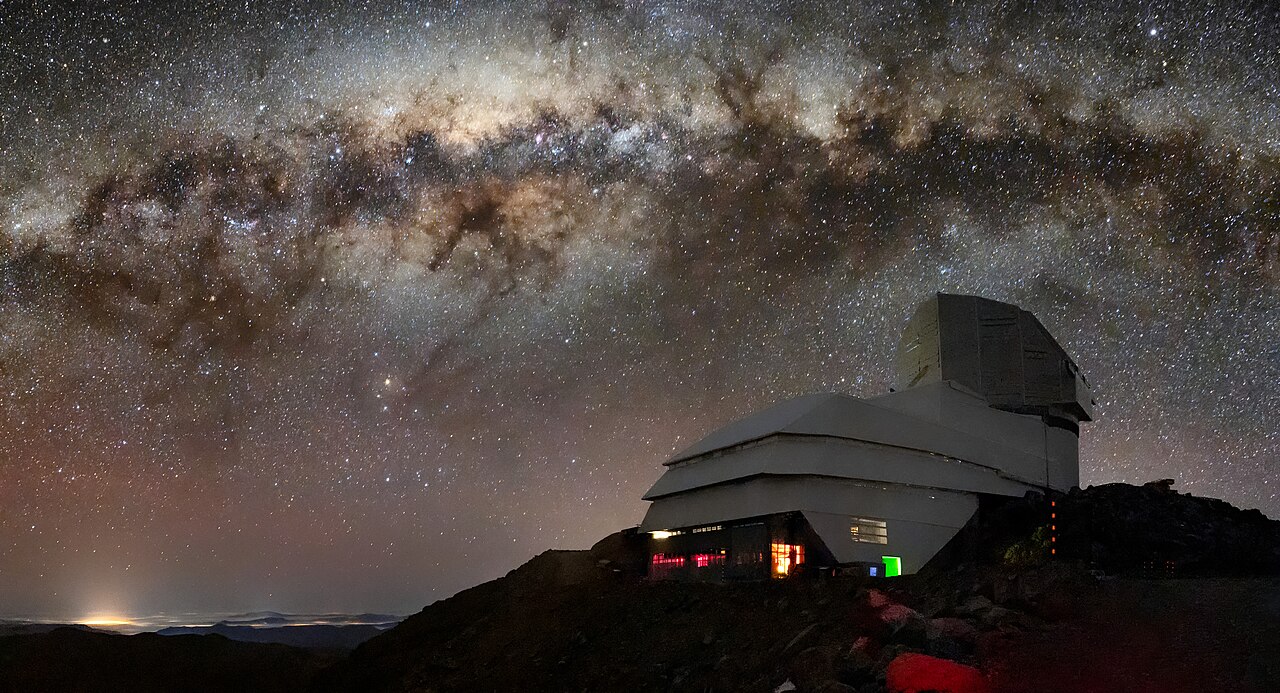
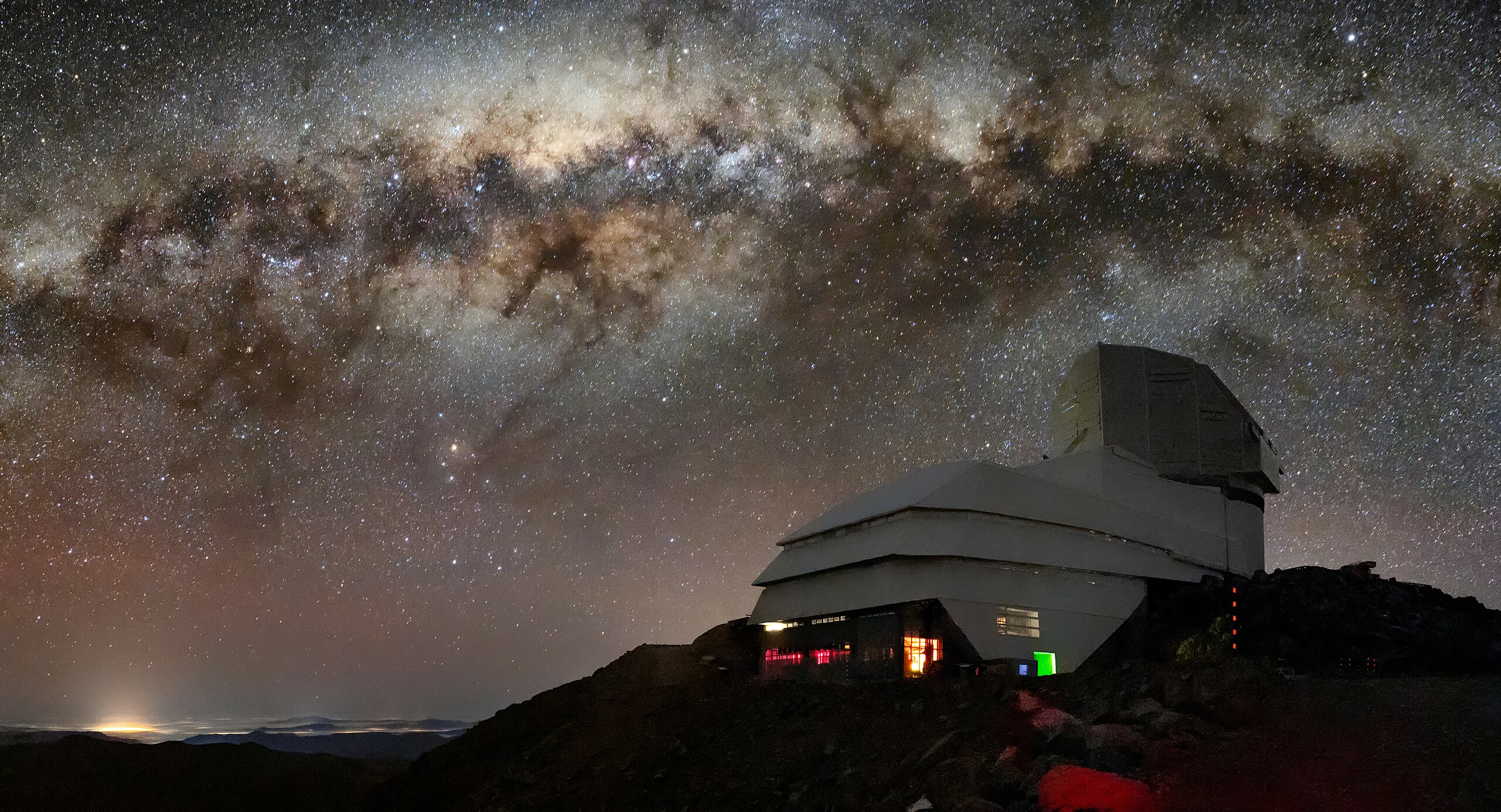
AçıklamaRubin Observatory and Its Target.jpg
English: This image captures not only Vera C. Rubin Observatory, a Program of NSF’s NOIRLab, but one of the celestial specimens Rubin Observatory will observe when it comes online: the Milky Way. The bright halo of gas and stars on the left side of the image highlights the very center of the Milky Way galaxy. The dark path that cuts through this center is known as the Great Rift, because it gives the appearance that the Milky Way has been split in half, right through its center and along its radial arms. In fact, the Great Rift is caused by a shroud of dust, which blocks and scatters visible light. This dust makes the Great Rift a difficult space to observe. Fortunately, Rubin is being built to conduct the Legacy Survey of Space and Time (LSST). This survey will observe the entire visible southern sky every few nights over the course of a decade, capturing about 1000 images of the sky every night and giving us a new view of our evolving Universe. The LSST is set to probe four areas of science, one of which is mapping the Milky Way to answer questions about its structure and formation. Once Rubin Observatory comes online in 2024, scientists will be able to access the data taken every night of operation. Rubin Observatory is a joint initiative of the National Science Foundation and the Department of Energy (DOE). Once completed, Rubin will be operated jointly by NSF’s NOIRLab and DOE's SLAC National Accelerator Laboratory to carry out the Legacy Survey of Space and Time.
Español: Esta imagen no sólo captura el Observatorio Vera C. Rubin, un Programa de NOIRLab de NSF, sino que también a uno de los especímenes celestes que el Observatorio Rubin observará cuando entre en funcionamiento: la Vía Láctea. El halo brillante de gas y estrellas en la parte izquierda de la imagen destaca el centro mismo de nuestra galaxia. El sendero oscuro que atraviesa este centro se conoce como la Gran Grieta, porque da la impresión de que la Vía Láctea estuviese partida en dos, justo a través de su centro y a lo largo de sus brazos espirales. En realidad, la Gran Grieta está formada por un manto de polvo que bloquea y dispersa la luz visible, convirtiéndola en un espacio difícil de observar. Por suerte, Rubin se está construyendo para llevar a cabo la Investigación del Espacio-Tiempo como Legado para la Posteridad (LSST por sus siglas en inglés). Esta investigación observará por una década todo el cielo austral visible, capturando unas 1.000 imágenes del cielo cada noche y ofreciéndonos una nueva perspectiva de nuestro Universo en evolución. El LSST está destinado a explorar cuatro áreas de la ciencia, y una de ellas es mapear la Vía Láctea para responder interrogantes sobre su estructura y formación. Una vez que el Observatorio Rubin entre en operación en 2024, los científicos podrán acceder a los datos recopilados en cada noche de operación. El Observatorio Rubin es una iniciativa conjunta de la Fundación Nacional de Ciencias y el Departamento de Energía (DOE). Una vez completado, el Observatorio Rubin será operado conjuntamente por NOIRLab de NSF y el Laboratorio Nacional del Acelerador SLAC de DOE para llevar a cabo el estudio denominado Legacy Survey of Space and Time.
Tarih 16 Şubat 2022, 12:00:00
Kaynak https://noirlab.edu/public/images/iotw2207a/
Yazar Rubin Observatory/NSF/AURA/B. Quint

Lisanslama

This media was created by the National Optical-Infrared Astronomy Research Laboratory (NOIRLab).
Their website states: "Unless specifically noted, the images, videos, and music distributed on the public NOIRLab website, along with the texts of press releases, announcements, images of the week and captions; are licensed under a Creative Commons Attribution 4.0 International License, and may on a non-exclusive basis be reproduced without fee provided the credit is clear and visible."
To the uploader: You must provide a link (URL) to the original file and the authorship information if available.
w:tr:Creative Commons
atıf
Bu dosya Creative Commons Atıf 4.0 Uluslararası lisansı altında lisanslanmıştır.
Şu seçeneklerde özgürsünüz:
  • paylaşım – eser paylaşımı, dağıtımı ve iletimi
  • içeriği değiştirip uyarlama – eser adaptasyonu
Aşağıdaki koşullar geçerli olacaktır:
  • atıf – Esere yazar veya lisans sahibi tarafından belirtilen (ancak sizi ya da eseri kullanımınızı desteklediklerini ileri sürmeyecek bir) şekilde atıfta bulunmalısınız.
https://creativecommons.org/licenses/by/4.0CC BY 4.0 Creative Commons Attribution 4.0 truetrue

Altyazılar

Bu dosyanın temsil ettiği şeyin tek satırlık açıklamasını ekleyin.

Bu dosyada gösterilen öğeler

betimlenen

Vera C. Rubin Gözlemevi

telif hakkı durumu

telif hakkı alınmış

telif hakkı lisansı

Creative Commons Atıf 4.0 Uluslararası

kuruluşu

16 Şubat 2022

ortam türü

image/jpeg

dosya boyutu

9.214.982 bayt

boyu

4.002 piksel

genişliği

7.396 piksel

sağlama toplamı

8fe6916559db29a026dd87bbf6b25d048e95bff2

tespit yöntemi: SHA-1

Dosya geçmişi

Dosyanın herhangi bir zamandaki hâli için ilgili tarih/saat kısmına tıklayın.

Tarih/SaatKüçük resimBoyutlarKullanıcıYorum
güncel18.00, 22 Haziran 202318.00, 22 Haziran 2023 tarihindeki sürümün küçültülmüş hâli7.396 × 4.002 (8,79 MB)C messierfull size
19.37, 30 Ocak 202319.37, 30 Ocak 2023 tarihindeki sürümün küçültülmüş hâli1.280 × 692 (244 KB)Yiseth RomeroUploaded a work by Rubin Observatory/NSF/AURA/B. Quint from https://noirlab.edu/public/images/iotw2207a/ with UploadWizard

Dosya kullanımı

Bu görüntü dosyasına bağlantısı olan sayfalar:

  • Vera C. Rubin Gözlemevi

Küresel dosya kullanımı

Aşağıdaki diğer vikiler bu dosyayı kullanmaktadır:

  • cs.wikipedia.org üzerinde kullanımı
    • Observatoř Very C. Rubinové
  • da.wikipedia.org üzerinde kullanımı
    • Vera Rubin
  • de.wikipedia.org üzerinde kullanımı
    • Vera C. Rubin Observatory
  • en.wikipedia.org üzerinde kullanımı
    • Vera Rubin
    • Vera C. Rubin Observatory
    • Wikipedia:In the news/Candidates/June 2025
    • Wikipedia:Main Page history/2025 June 23b
    • Wikipedia:Main Page history/2025 June 24
    • Wikipedia:Main Page history/2025 June 24b
    • Wikipedia:Main Page history/2025 June 25
    • Wikipedia:Main Page history/2025 June 25b
  • en.wikiquote.org üzerinde kullanımı
    • Wikiquote:Quote of the day/July 2025
    • Wikiquote:Quote of the day/July 16, 2025
  • et.wikipedia.org üzerinde kullanımı
    • Vera C. Rubini Observatoorium
  • fi.wikipedia.org üzerinde kullanımı
    • Vera C. Rubin -observatorio
  • he.wikipedia.org üzerinde kullanımı
    • מצפה הכוכבים ורה רובין
  • hu.wikipedia.org üzerinde kullanımı
    • Vera Rubin
  • hy.wikipedia.org üzerinde kullanımı
    • Վերա Ռուբին
  • id.wikipedia.org üzerinde kullanımı
    • Vera Rubin
    • Wikipedia:Peristiwa terkini/Juni 2025
    • Wikipedia:Arsip halaman utama/2025/06/23
    • Wikipedia:Arsip halaman utama/2025/06/24
    • Wikipedia:Arsip halaman utama/2025/06/25
    • Wikipedia:Arsip halaman utama/2025/06/26
    • Wikipedia:Arsip halaman utama/2025/06/27
    • Wikipedia:Arsip halaman utama/2025/06/28
    • Wikipedia:Arsip halaman utama/2025/06/29
    • Wikipedia:Arsip halaman utama/2025/06/30
    • Wikipedia:Arsip halaman utama/2025/07/01
    • Wikipedia:Peristiwa terkini/Juli 2025
  • ko.wikipedia.org üzerinde kullanımı
    • 베라루빈 천문대
  • ms.wikipedia.org üzerinde kullanımı
    • Balai Cerap Vera C. Rubin
  • nl.wikipedia.org üzerinde kullanımı
    • Vera C. Rubin Observatory
  • sl.wikipedia.org üzerinde kullanımı
    • Observatorij Vere C. Rubin
  • sr.wikipedia.org üzerinde kullanımı
    • Опсерваторија Вера Ц. Рубин
  • uk.wikipedia.org üzerinde kullanımı
    • Вера Рубін
  • zh.wikipedia.org üzerinde kullanımı
    • 薇拉·魯賓天文台
    • Wikipedia:新闻动态候选/存档/2025年6月

Üstveri

Bu dosyada, muhtemelen fotoğraf makinesi ya da tarayıcı tarafından eklenmiş ek bilgiler mevcuttur. Eğer dosyada sonradan değişiklik yapıldıysa, bazı bilgiler yeni değişikliğe göre eski kalmış olabilir.

Katkı/Sağlayıcı Rubin Observatory/NSF/AURA/B. Quint
KaynakNSF's NOIRLab
Kısa başlık
  • Rubin Observatory and Its Target
Resim başlığı
  • This image captures not only Vera C. Rubin Observatory, a Program of NSF’s NOIRLab, but one of the celestial specimens Rubin Observatory will observe when it comes online: the Milky Way. The bright halo of gas and stars on the left side of the image highlights the very center of the Milky Way galaxy. The dark path that cuts through this center is known as the Great Rift, because it gives the appearance that the Milky Way has been split in half, right through its center and along its radial arms. In fact, the Great Rift is caused by a shroud of dust, which blocks and scatters visible light. This dust makes the Great Rift a difficult space to observe. Fortunately,Rubin is being built to conduct the Legacy Survey of Space and Time (LSST). This survey will observe the entire visible southern sky every few nights over the course of a decade, capturing about 1000 images of the sky every night and giving us a new view of our evolving Universe. The LSST is set toprobe four areas of science, one of which is mapping the Milky Way to answer questions about its structure and formation. Once Rubin Observatory comes online in 2024, scientists will be able to access the data taken every night of operation. Rubin Observatory is a joint initiative of the National Science Foundation and the Department of Energy (DOE). Once completed, Rubin will be operated jointly by NSF’s NOIRLab and DOE's SLAC National Accelerator Laboratory to carry out the Legacy Survey of Space and Time.
Kullanım şartları
  • Creative Commons Attribution 4.0 International License
Verinin ilk yaratılma zamanı12.00, 16 Şubat 2022
JPEG dosyası yorumuThis image captures not only Vera C. Rubin Observatory, a Program of NSF’s NOIRLab, but one of the celestial specimens Rubin Observatory will observe when it comes online: the Milky Way. The bright halo of gas and stars on the left side of the image highlights the very center of the Milky Way galaxy. The dark path that cuts through this center is known as the Great Rift, because it gives the appearance that the Milky Way has been split in half, right through its center and along its radial arms. In fact, the Great Rift is caused by a shroud of dust, which blocks and scatters visible light. This dust makes the Great Rift a difficult space to observe. Fortunately, Rubin is being built to conduct the Legacy Survey of Space and Time (LSST). This survey will observe the entire visible southern sky every few nights over the course of a decade, capturing about 1000 images of the sky every night and giving us a new view of our evolving Universe. The LSST is set to probe four areas of science, one of which is mapping the Milky Way to answer questions about its structure and formation. Once Rubin Observatory comes online in 2024, scientists will be able to access the data taken every night of operation. Rubin Observatory is a joint initiative of the National Science Foundation and the Department of Energy (DOE). Once completed, Rubin will be operated jointly by NSF’s NOIRLab and DOE's SLAC National Accelerator Laboratory to carry out the Legacy Survey of Space and Time.
Kullanılan yazılımAdobe Photoshop 23.0 (Windows)
Dosya değişiklik tarihi ve zamanı10.52, 3 Aralık 2021
Dijitalleştirme zamanı04.44, 9 Temmuz 2021
Üst veri son değişim tarihi03.52, 3 Aralık 2021
Özgün belgenin benzersiz kimliğixmp.did:63759b61-539f-b945-bab7-92a526b9b8e0
İletişim bilgileri

https://noirlab.edu

950 North Cherry Ave.

Tucson, AZ, 85719 USA

IIM sürümü4
"https://tr.wikipedia.org/wiki/Dosya:Rubin_Observatory_and_Its_Target.jpg" sayfasından alınmıştır
  • Gizlilik politikası
  • Vikipedi hakkında
  • Sorumluluk reddi
  • Davranış Kuralları
  • Geliştiriciler
  • İstatistikler
  • Çerez politikası
  • Mobil görünüm
  • Wikimedia Foundation
  • Powered by MediaWiki
Dosya:Rubin Observatory and Its Target.jpg
Konu ekle