Bohr-Mollerup teoremi - Vikipedi
İçeriğe atla
Ana menü
Gezinti
  • Anasayfa
  • Hakkımızda
  • İçindekiler
  • Rastgele madde
  • Seçkin içerik
  • Yakınımdakiler
Katılım
  • Deneme tahtası
  • Köy çeşmesi
  • Son değişiklikler
  • Dosya yükle
  • Topluluk portalı
  • Wikimedia dükkânı
  • Yardım
  • Özel sayfalar
Vikipedi Özgür Ansiklopedi
Ara
  • Bağış yapın
  • Hesap oluştur
  • Oturum aç
  • Bağış yapın
  • Hesap oluştur
  • Oturum aç

İçindekiler

  • Giriş
  • 1 Kanıtı
    • 1.1 Teoremin ifadesi
    • 1.2 Kanıtı
  • 2 Kaynakça

Bohr-Mollerup teoremi

  • Bosanski
  • Català
  • Dansk
  • Deutsch
  • English
  • Español
  • Français
  • עברית
  • Bahasa Indonesia
  • İtaliano
  • 日本語
  • 한국어
  • Русский
  • Српски / srpski
  • Svenska
  • ไทย
  • Українська
  • 中文
Bağlantıları değiştir
  • Madde
  • Tartışma
  • Oku
  • Değiştir
  • Kaynağı değiştir
  • Geçmişi gör
Araçlar
Eylemler
  • Oku
  • Değiştir
  • Kaynağı değiştir
  • Geçmişi gör
Genel
  • Sayfaya bağlantılar
  • İlgili değişiklikler
  • Kalıcı bağlantı
  • Sayfa bilgisi
  • Bu sayfayı kaynak göster
  • Kısaltılmış URL'yi al
  • Karekodu indir
Yazdır/dışa aktar
  • Bir kitap oluştur
  • PDF olarak indir
  • Basılmaya uygun görünüm
Diğer projelerde
  • Vikiveri ögesi
Görünüm
Vikipedi, özgür ansiklopedi

Bohr-Mollerup teoremi,[1][2] Matematiksel analizde adını Danimarkalı matematikçi Harald Bohr ve Johannes Mollerup'tan almıştır.[3]

Bu teorem x > 0 için Gama fonksiyonu'nun, karakterizasyonu'nu tanımlar.

Γ ( x ) = ∫ 0 ∞ t x − 1 e − t d t {\displaystyle \Gamma (x)=\int _{0}^{\infty }t^{x-1}e^{-t}\,dt} {\displaystyle \Gamma (x)=\int _{0}^{\infty }t^{x-1}e^{-t}\,dt}

sade fonksiyon ƒ için x > 0 açık aralığında ardı ardına üç özellik

  • f ( 1 ) = 1 , {\displaystyle f(1)=1,\,} {\displaystyle f(1)=1,\,} ve
  • f ( x + 1 ) = x f ( x )  for  x > 0 , {\displaystyle f(x+1)=xf(x){\text{ for }}x>0,\,} {\displaystyle f(x+1)=xf(x){\text{ for }}x>0,\,} ve
  • f {\displaystyle f} {\displaystyle f} logaritmik konveksdir.

Bu teoremin seçkin açıklaması Artin'in kitabı The Gamma Function'un yeniden basımı bir AMS koleksiyonudur ve Artin tarafından kaleme alınmıştır.

İlk baskı Karmaşık Analiz içindeydi ve Bohr ve Mollerup'un izniyle basılmıştır.

Kanıtı

[değiştir | kaynağı değiştir]

Teoremin ifadesi

[değiştir | kaynağı değiştir]

Γ ( z ) {\displaystyle \,\Gamma (z)\,} {\displaystyle \,\Gamma (z)\,} karşılayan tek fonksiyon f ( z + 1 ) = z f ( z ) {\displaystyle \,f(z+1)=zf(z)\,} {\displaystyle \,f(z+1)=zf(z)\,} ile log ⁡ ( f ( z ) ) {\displaystyle \,\log(f(z))\,} {\displaystyle \,\log(f(z))\,} ve ayrıca f ( 1 ) = 1 {\displaystyle \,f(1)=1\,} {\displaystyle \,f(1)=1\,}.için konvekstir.

Kanıtı

[değiştir | kaynağı değiştir]
Γ ( x ) {\displaystyle \,\Gamma (x)\,} {\displaystyle \,\Gamma (x)\,} yardımıyla, yukarıda kabul edilen özelliklere bağlı olarak kurulan fonksiyon

Γ ( x + 1 ) = x Γ ( x ) {\displaystyle \,\Gamma (x+1)=x\Gamma (x)\,} {\displaystyle \,\Gamma (x+1)=x\Gamma (x)\,} ve log ⁡ ( Γ ( x ) ) {\displaystyle \,\log \left(\Gamma (x)\right)\,} {\displaystyle \,\log \left(\Gamma (x)\right)\,} konvekstir ve
Γ ( 1 ) = 1 {\displaystyle \,\Gamma (1)=1\,} {\displaystyle \,\Gamma (1)=1\,}

Aslında Γ ( x + 1 ) = x Γ ( x ) {\displaystyle \,\Gamma (x+1)=x\Gamma (x)\,} {\displaystyle \,\Gamma (x+1)=x\Gamma (x)\,} gerçeğinden şunu kurabiliriz.

Γ ( x + n ) = ( x + n − 1 ) ( x + n − 2 ) ( x + n − 3 ) … ( x + 1 ) x Γ ( x ) {\displaystyle \,{\begin{aligned}\Gamma (x+n)=(x+n-1)(x+n-2)(x+n-3)\ldots (x+1)x\Gamma (x)\end{aligned}}\,} {\displaystyle \,{\begin{aligned}\Gamma (x+n)=(x+n-1)(x+n-2)(x+n-3)\ldots (x+1)x\Gamma (x)\end{aligned}}\,}

ve bu sonuçtan hareketle

Γ ( 1 ) = 1 {\displaystyle \,\Gamma (1)=1\,} {\displaystyle \,\Gamma (1)=1\,} ifadesi Γ ( x + 1 ) = x Γ ( x ) {\displaystyle \,\Gamma (x+1)=x\Gamma (x)\,} {\displaystyle \,\Gamma (x+1)=x\Gamma (x)\,} doğal sonucudur bu özellikle tam sayılara uygulanarak aşağıdaki sonuca varabiliriz.

Γ ( n ) = ( n − 1 ) ! {\displaystyle \,\Gamma (n)=(n-1)!\,} {\displaystyle \,\Gamma (n)=(n-1)!\,} ise n ∈ N {\displaystyle \,n\in \mathbb {N} \,} {\displaystyle \,n\in \mathbb {N} \,}

ve eğer Γ ( x ) {\displaystyle \,\Gamma (x)\,} {\displaystyle \,\Gamma (x)\,} yoksa... yani bizim bağıntımız

0 < x ≤ 1 {\displaystyle \,0<x\leq 1\,} {\displaystyle \,0<x\leq 1\,} olmak üzere
Γ ( x + n ) {\displaystyle \,\Gamma (x+n)\,} {\displaystyle \,\Gamma (x+n)\,}
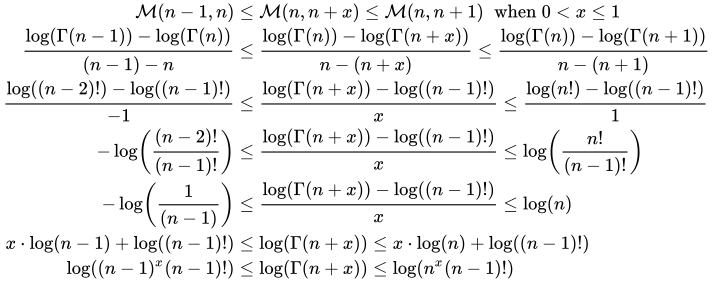
Γ ( x ) {\displaystyle \,\Gamma (x)\,} {\displaystyle \,\Gamma (x)\,} tüm x {\displaystyle \,x\,} {\displaystyle \,x\,} değerleri için aşağıdaki ( x 1 , f ( x 1 ) ) {\displaystyle \,(x_{1},\;f(x_{1}))\,} {\displaystyle \,(x_{1},\;f(x_{1}))\,} ve ( x 2 , f ( x 2 ) ) {\displaystyle \,(x_{2},\;f(x_{2}))\,} {\displaystyle \,(x_{2},\;f(x_{2}))\,} iki noktayı birleştiren doğrunun eğiminin hesabı x 1 < x 2 {\displaystyle \,x_{1}<x_{2}\,} {\displaystyle \,x_{1}<x_{2}\,} olmak üzere M ( x 1 , x 2 ) {\displaystyle \,{\mathcal {M}}(x_{1},x_{2})\,} {\displaystyle \,{\mathcal {M}}(x_{1},x_{2})\,} monoton olarak arttığı için konveks fonksiyon ile onun doğal öngörüsüden dolayı log ⁡ ( Γ ( x ) ) {\displaystyle \,\log \left(\Gamma (x)\right)\,} {\displaystyle \,\log \left(\Gamma (x)\right)\,} konveks olduğunu biliyoruz
M ( n − 1 , n ) ≤ M ( n , n + x ) ≤ M ( n , n + 1 ) w h e n 0 < x ≤ 1 log ⁡ ( Γ ( n − 1 ) ) − log ⁡ ( Γ ( n ) ) ( n − 1 ) − n ≤ log ⁡ ( Γ ( n ) ) − log ⁡ ( Γ ( n + x ) ) n − ( n + x ) ≤ log ⁡ ( Γ ( n ) ) − log ⁡ ( Γ ( n + 1 ) ) n − ( n + 1 ) log ⁡ ( ( n − 2 ) ! ) − log ⁡ ( ( n − 1 ) ! ) − 1 ≤ log ⁡ ( Γ ( n + x ) ) − log ⁡ ( ( n − 1 ) ! ) x ≤ log ⁡ ( n ! ) − log ⁡ ( ( n − 1 ) ! ) 1 − log ⁡ ( ( n − 2 ) ! ( n − 1 ) ! ) ≤ log ⁡ ( Γ ( n + x ) ) − log ⁡ ( ( n − 1 ) ! ) x ≤ log ⁡ ( n ! ( n − 1 ) ! ) − log ⁡ ( 1 ( n − 1 ) ) ≤ log ⁡ ( Γ ( n + x ) ) − log ⁡ ( ( n − 1 ) ! ) x ≤ log ⁡ ( n ) x ⋅ log ⁡ ( n − 1 ) + log ⁡ ( ( n − 1 ) ! ) ≤ log ⁡ ( Γ ( n + x ) ) ≤ x ⋅ log ⁡ ( n ) + log ⁡ ( ( n − 1 ) ! ) log ⁡ ( ( n − 1 ) x ( n − 1 ) ! ) ≤ log ⁡ ( Γ ( n + x ) ) ≤ log ⁡ ( n x ( n − 1 ) ! ) {\displaystyle {\begin{aligned}{\mathcal {M}}(n-1,n)&\leq {\mathcal {M}}(n,n+x)\leq {\mathcal {M}}(n,n+1)\;\;\mathrm {when} \;0<x\leq 1\\{\frac {\log \left(\Gamma (n-1)\right)-\log \left(\Gamma (n)\right)}{(n-1)-n}}&\leq {\frac {\log \left(\Gamma (n)\right)-\log \left(\Gamma (n+x)\right)}{n-(n+x)}}\leq {\frac {\log \left(\Gamma (n)\right)-\log \left(\Gamma (n+1)\right)}{n-(n+1)}}\\{\frac {\log \left((n-2)!\right)-\log \left((n-1)!\right)}{-1}}&\leq {\frac {\log \left(\Gamma (n+x)\right)-\log \left((n-1)!\right)}{x}}\leq {\frac {\log \left(n!\right)-\log \left((n-1)!\right)}{1}}\\-\log \left({\frac {(n-2)!}{(n-1)!}}\right)&\leq {\frac {\log \left(\Gamma (n+x)\right)-\log \left((n-1)!\right)}{x}}\leq \log \left({\frac {n!}{(n-1)!}}\right)\\-\log \left({\frac {1}{(n-1)}}\right)&\leq {\frac {\log \left(\Gamma (n+x)\right)-\log \left((n-1)!\right)}{x}}\leq \log \left(n\right)\\x\cdot \log \left(n-1\right)+\log \left((n-1)!\right)&\leq \log \left(\Gamma (n+x)\right)\leq x\cdot \log \left(n\right)+\log \left((n-1)!\right)\\\log \left((n-1)^{x}(n-1)!\right)&\leq \log \left(\Gamma (n+x)\right)\leq \log \left(n^{x}(n-1)!\right)\end{aligned}}} {\displaystyle {\begin{aligned}{\mathcal {M}}(n-1,n)&\leq {\mathcal {M}}(n,n+x)\leq {\mathcal {M}}(n,n+1)\;\;\mathrm {when} \;0<x\leq 1\\{\frac {\log \left(\Gamma (n-1)\right)-\log \left(\Gamma (n)\right)}{(n-1)-n}}&\leq {\frac {\log \left(\Gamma (n)\right)-\log \left(\Gamma (n+x)\right)}{n-(n+x)}}\leq {\frac {\log \left(\Gamma (n)\right)-\log \left(\Gamma (n+1)\right)}{n-(n+1)}}\\{\frac {\log \left((n-2)!\right)-\log \left((n-1)!\right)}{-1}}&\leq {\frac {\log \left(\Gamma (n+x)\right)-\log \left((n-1)!\right)}{x}}\leq {\frac {\log \left(n!\right)-\log \left((n-1)!\right)}{1}}\\-\log \left({\frac {(n-2)!}{(n-1)!}}\right)&\leq {\frac {\log \left(\Gamma (n+x)\right)-\log \left((n-1)!\right)}{x}}\leq \log \left({\frac {n!}{(n-1)!}}\right)\\-\log \left({\frac {1}{(n-1)}}\right)&\leq {\frac {\log \left(\Gamma (n+x)\right)-\log \left((n-1)!\right)}{x}}\leq \log \left(n\right)\\x\cdot \log \left(n-1\right)+\log \left((n-1)!\right)&\leq \log \left(\Gamma (n+x)\right)\leq x\cdot \log \left(n\right)+\log \left((n-1)!\right)\\\log \left((n-1)^{x}(n-1)!\right)&\leq \log \left(\Gamma (n+x)\right)\leq \log \left(n^{x}(n-1)!\right)\end{aligned}}}

Böyle bir limit varlığı veya yakınsama gibi çeşitli şeyleri kanıtlamak için ortak bir analiz tekniğidir. Şimdi biz bu fonksiyonu geri çağırıyoruz ve her ikisi monoton artandır. Bu, iki ifade arasında sıkışmış olan fonksiyon son satırından bellidir log ⁡ ( ) {\displaystyle \,\log()\,} {\displaystyle \,\log()\,} ve e ( ) {\displaystyle \,e^{()}\,} {\displaystyle \,e^{()}\,} . biz bu özelliği eşitsizlikte kullanırsak devamla:

( n − 1 ) x ( n − 1 ) ! ≤ Γ ( n + x ) ≤ n x ( n − 1 ) ! ( n − 1 ) x ( n − 1 ) ! ≤ ( x + n − 1 ) ( x + n − 2 ) … ( x + 1 ) x Γ ( x ) ≤ n x ( n − 1 ) ! ( n − 1 ) x ( n − 1 ) ! ( x + n − 1 ) ( x + n − 2 ) … ( x + 1 ) x ≤ Γ ( x ) ≤ n x ( n − 1 ) ! ( x + n − 1 ) ( x + n − 2 ) … ( x + 1 ) x ( n − 1 ) x ( n − 1 ) ! ( x + n − 1 ) ( x + n − 2 ) … ( x + 1 ) x ≤ Γ ( x ) ≤ n x n ! ( x + n ) ( x + n − 1 ) … ( x + 1 ) x ( n + x n ) {\displaystyle \,{\begin{aligned}(n-1)^{x}(n-1)!&\leq \Gamma (n+x)\leq n^{x}(n-1)!\\(n-1)^{x}(n-1)!&\leq (x+n-1)(x+n-2)\ldots (x+1)x\Gamma (x)\leq n^{x}(n-1)!\\{\frac {(n-1)^{x}(n-1)!}{(x+n-1)(x+n-2)\ldots (x+1)x}}\leq \Gamma (x)&\leq {\frac {n^{x}(n-1)!}{(x+n-1)(x+n-2)\ldots (x+1)x}}\\{\frac {(n-1)^{x}(n-1)!}{(x+n-1)(x+n-2)\ldots (x+1)x}}&\leq \Gamma (x)\leq {\frac {n^{x}n!}{(x+n)(x+n-1)\ldots (x+1)x}}\left({\frac {n+x}{n}}\right)\\\end{aligned}}\,} {\displaystyle \,{\begin{aligned}(n-1)^{x}(n-1)!&\leq \Gamma (n+x)\leq n^{x}(n-1)!\\(n-1)^{x}(n-1)!&\leq (x+n-1)(x+n-2)\ldots (x+1)x\Gamma (x)\leq n^{x}(n-1)!\\{\frac {(n-1)^{x}(n-1)!}{(x+n-1)(x+n-2)\ldots (x+1)x}}\leq \Gamma (x)&\leq {\frac {n^{x}(n-1)!}{(x+n-1)(x+n-2)\ldots (x+1)x}}\\{\frac {(n-1)^{x}(n-1)!}{(x+n-1)(x+n-2)\ldots (x+1)x}}&\leq \Gamma (x)\leq {\frac {n^{x}n!}{(x+n)(x+n-1)\ldots (x+1)x}}\left({\frac {n+x}{n}}\right)\\\end{aligned}}\,}

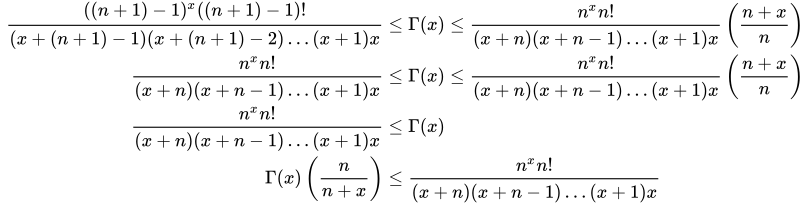
Son satırı güçlü bir ifadedir. Özelde, bütün n {\displaystyle \,n\,} {\displaystyle \,n\,} değerler için de geçerlidir. Γ ( x ) {\displaystyle \,\Gamma (x)\,} {\displaystyle \,\Gamma (x)\,} nın herhangi bir n {\displaystyle \,n\,} {\displaystyle \,n\,} değeri seçimi için sağ tarafta daha küçük ve aynı şekilde, Γ ( x ) {\displaystyle \,\Gamma (x)\,} {\displaystyle \,\Gamma (x)\,} nın herhangi bir n {\displaystyle \,n\,} {\displaystyle \,n\,} diğer tercihi için sol tarafta daha büyük olmasıdır. Her bir eşitsizlik yalnız bir durum ve bağımsız bir ifade olarak yorumlanabilir bir durumdur. bu nedenle RHS ve LHS'yi farklı -n-değerleri için seçmekte özgürüz. Özellikle, LHS için n + 1 {\displaystyle \,n+1\,} {\displaystyle \,n+1\,} RHS için n {\displaystyle \,n\,} {\displaystyle \,n\,} seçiminde tutarsak.

( ( n + 1 ) − 1 ) x ( ( n + 1 ) − 1 ) ! ( x + ( n + 1 ) − 1 ) ( x + ( n + 1 ) − 2 ) … ( x + 1 ) x ≤ Γ ( x ) ≤ n x n ! ( x + n ) ( x + n − 1 ) … ( x + 1 ) x ( n + x n ) n x n ! ( x + n ) ( x + n − 1 ) … ( x + 1 ) x ≤ Γ ( x ) ≤ n x n ! ( x + n ) ( x + n − 1 ) … ( x + 1 ) x ( n + x n ) n x n ! ( x + n ) ( x + n − 1 ) … ( x + 1 ) x ≤ Γ ( x ) Γ ( x ) ( n n + x ) ≤ n x n ! ( x + n ) ( x + n − 1 ) … ( x + 1 ) x {\displaystyle \,{\begin{aligned}{\frac {((n+1)-1)^{x}((n+1)-1)!}{(x+(n+1)-1)(x+(n+1)-2)\ldots (x+1)x}}&\leq \Gamma (x)\leq {\frac {n^{x}n!}{(x+n)(x+n-1)\ldots (x+1)x}}\left({\frac {n+x}{n}}\right)\\{\frac {n^{x}n!}{(x+n)(x+n-1)\ldots (x+1)x}}&\leq \Gamma (x)\leq {\frac {n^{x}n!}{(x+n)(x+n-1)\ldots (x+1)x}}\left({\frac {n+x}{n}}\right)\\{\frac {n^{x}n!}{(x+n)(x+n-1)\ldots (x+1)x}}&\leq \Gamma (x)\\\Gamma (x)\left({\frac {n}{n+x}}\right)&\leq {\frac {n^{x}n!}{(x+n)(x+n-1)\ldots (x+1)x}}\end{aligned}}\,} {\displaystyle \,{\begin{aligned}{\frac {((n+1)-1)^{x}((n+1)-1)!}{(x+(n+1)-1)(x+(n+1)-2)\ldots (x+1)x}}&\leq \Gamma (x)\leq {\frac {n^{x}n!}{(x+n)(x+n-1)\ldots (x+1)x}}\left({\frac {n+x}{n}}\right)\\{\frac {n^{x}n!}{(x+n)(x+n-1)\ldots (x+1)x}}&\leq \Gamma (x)\leq {\frac {n^{x}n!}{(x+n)(x+n-1)\ldots (x+1)x}}\left({\frac {n+x}{n}}\right)\\{\frac {n^{x}n!}{(x+n)(x+n-1)\ldots (x+1)x}}&\leq \Gamma (x)\\\Gamma (x)\left({\frac {n}{n+x}}\right)&\leq {\frac {n^{x}n!}{(x+n)(x+n-1)\ldots (x+1)x}}\end{aligned}}\,}

Bu son iki ifadeyi birleştirirsek

Γ ( x ) ( n n + x ) ≤ n x n ! ( x + n ) ( x + n − 1 ) … ( x + 1 ) x ≤ Γ ( x ) {\displaystyle \,{\begin{aligned}\Gamma (x)\left({\frac {n}{n+x}}\right)\leq {\frac {n^{x}n!}{(x+n)(x+n-1)\ldots (x+1)x}}\leq \Gamma (x)\end{aligned}}\,} {\displaystyle \,{\begin{aligned}\Gamma (x)\left({\frac {n}{n+x}}\right)\leq {\frac {n^{x}n!}{(x+n)(x+n-1)\ldots (x+1)x}}\leq \Gamma (x)\end{aligned}}\,}

şimdi n → ∞ {\displaystyle \,n\rightarrow \infty \,} {\displaystyle \,n\rightarrow \infty \,}olarak alınırsa. n n + x → 1 {\displaystyle \,{\frac {n}{n+x}}\rightarrow 1\,} {\displaystyle \,{\frac {n}{n+x}}\rightarrow 1\,} sağ yan eşitliğe giderken sol yan eşitsizliğe gider. n x n ! ( x + n ) ( x + n − 1 ) … ( x + 1 ) x {\displaystyle \,{\frac {n^{x}n!}{(x+n)(x+n-1)\ldots (x+1)x}}\,} {\displaystyle \,{\frac {n^{x}n!}{(x+n)(x+n-1)\ldots (x+1)x}}\,} devamlı sıkıştırılırsa, lim n → ∞ n x n ! ( x + n ) ( x + n − 1 ) … ( x + 1 ) x {\displaystyle \,\lim _{n\rightarrow \infty }{\frac {n^{x}n!}{(x+n)(x+n-1)\ldots (x+1)x}}\,} {\displaystyle \,\lim _{n\rightarrow \infty }{\frac {n^{x}n!}{(x+n)(x+n-1)\ldots (x+1)x}}\,} ifadesinin tek anlamı olabilir,eşitlik Γ ( x ) {\displaystyle \,\Gamma (x)\,} {\displaystyle \,\Gamma (x)\,}'ya gider. Bu ispat bağlamında lim n → ∞ n x n ! ( x + n ) ( x + n − 1 ) … ( x + 1 ) x {\displaystyle \,\lim _{n\rightarrow \infty }{\frac {n^{x}n!}{(x+n)(x+n-1)\ldots (x+1)x}}\,} {\displaystyle \,\lim _{n\rightarrow \infty }{\frac {n^{x}n!}{(x+n)(x+n-1)\ldots (x+1)x}}\,} Γ ( x ) {\displaystyle \,\Gamma (x)\,} {\displaystyle \,\Gamma (x)\,}'ya ait belirtilen üç özellik idi. Ayrıca kanıt Γ ( x ) {\displaystyle \,\Gamma (x)\,} {\displaystyle \,\Gamma (x)\,} için belirli bir ifade sağlar Ve ispatın son kritik bölümünde bir dizinin limiti benzersiz olduğu hatırdan çıkarılmamalıdır Bu demektir ki herhangi bir x ∈ ( 0 , 1 ] {\displaystyle \,x\in (0,1]\,} {\displaystyle \,x\in (0,1]\,} seçim için, sadece bir sayı Γ ( x ) {\displaystyle \,\Gamma (x)\,} {\displaystyle \,\Gamma (x)\,} bulunabilir Burada Γ ( x ) {\displaystyle \,\Gamma (x)\,} {\displaystyle \,\Gamma (x)\,} fonksiyonun tüm özelliklerine sahip başka bir fonksiyon yoktur.

ispat sorusunun teorem varsayımı kalan diğer ucudur Γ ( x ) {\displaystyle \,\Gamma (x)\,} {\displaystyle \,\Gamma (x)\,} herkes için mantıklı x {\displaystyle \,x\,} {\displaystyle \,x\,} burada lim n → ∞ n x n ! ( x + n ) ( x + n − 1 ) … ( x + 1 ) x {\displaystyle \,\lim _{n\rightarrow \infty }{\frac {n^{x}n!}{(x+n)(x+n-1)\ldots (x+1)x}}\,} {\displaystyle \,\lim _{n\rightarrow \infty }{\frac {n^{x}n!}{(x+n)(x+n-1)\ldots (x+1)x}}\,} bulunmaktadır. Problem bizim ilk çift eşitsizliğimizdedir.

M ( n − 1 , n ) ≤ M ( n + x , n ) ≤ M ( n + 1 , n ) {\displaystyle \,{\begin{aligned}{\mathcal {M}}(n-1,n)\leq {\mathcal {M}}(n+x,n)\leq {\mathcal {M}}(n+1,n)\end{aligned}}\,} {\displaystyle \,{\begin{aligned}{\mathcal {M}}(n-1,n)\leq {\mathcal {M}}(n+x,n)\leq {\mathcal {M}}(n+1,n)\end{aligned}}\,}

0 < x ≤ 1 {\displaystyle \,0<x\leq 1\,} {\displaystyle \,0<x\leq 1\,} için kısıtlama konmuştur. öğleyse, monoton artan yapmak isteniyor, x > 1 {\displaystyle \,x>1\,} {\displaystyle \,x>1\,} daha sonra eğer M {\displaystyle \,{\mathcal {M}}\,} {\displaystyle \,{\mathcal {M}}\,} söyleniyorsa M ( n + 1 , n ) < M ( n + x , n ) {\displaystyle \,{\mathcal {M}}(n+1,n)<{\mathcal {M}}(n+x,n)\,} {\displaystyle \,{\mathcal {M}}(n+1,n)<{\mathcal {M}}(n+x,n)\,},olması isteniyorsa oluşturulan tüm kanıt eşitsizliğin çelişmesi üzerinedir ama

Γ ( x + 1 ) = lim n → ∞ x ⋅ ( n x n ! ( x + n ) ( x + n − 1 ) … ( x + 1 ) x ) n n + x + 1 Γ ( x ) = ( 1 x ) Γ ( x + 1 ) {\displaystyle \,{\begin{aligned}\Gamma (x+1)&=\lim _{n\rightarrow \infty }x\cdot \left({\frac {n^{x}n!}{(x+n)(x+n-1)\ldots (x+1)x}}\right){\frac {n}{n+x+1}}\\\Gamma (x)&=\left({\frac {1}{x}}\right)\Gamma (x+1)\end{aligned}}\,} {\displaystyle \,{\begin{aligned}\Gamma (x+1)&=\lim _{n\rightarrow \infty }x\cdot \left({\frac {n^{x}n!}{(x+n)(x+n-1)\ldots (x+1)x}}\right){\frac {n}{n+x+1}}\\\Gamma (x)&=\left({\frac {1}{x}}\right)\Gamma (x+1)\end{aligned}}\,}

dikkat edilmelidir.

ilk olarak gösterilen x {\displaystyle \,x\,} {\displaystyle \,x\,}'ın bütün değerleri için Γ ( x ) {\displaystyle \,\Gamma (x)\,} {\displaystyle \,\Gamma (x)\,}'ın buradaki limit tanımlıdır.

Kaynakça

[değiştir | kaynağı değiştir]
  1. ^ Hazewinkel, Michiel, (Ed.) (2001), "Bohr–Mollerup theorem", Encyclopaedia of Mathematics, Kluwer Academic Publishers, ISBN 978-1556080104 
  2. ^ Eric W. Weisstein, Bohr–Mollerup Theorem (MathWorld)
  3. ^ Mollerup, J., Bohr, H. (1922). Lærebog i Kompleks Analyse vol. III, Copenhagen. 
  • Eric W. Weisstein, Bohr-Mollerup teoremi (MathWorld)
  • Proof of Bohr–Mollerup theorem, PlanetMath.org.
  • Proof of Bohr–Mollerup theorem, PlanetMath.org.
  • Artin, Emil (1964). The Gamma Function. Holt, Rinehart, Winston. 
  • Rosen, Michael (2006). Exposition by Emil Artin: A Selection. American Mathematical Society. 
  • Mollerup, J., Bohr, H. (1922). Lærebog i Kompleks Analyse vol. III, Copenhagen.  (Textbook in Complex Analysis)

"https://tr.wikipedia.org/w/index.php?title=Bohr-Mollerup_teoremi&oldid=35061384" sayfasından alınmıştır
Kategoriler:
  • Gama ve ilişik fonksiyonlar
  • Karmaşık analiz teoremleri
  • Sayfa en son 23.14, 28 Şubat 2025 tarihinde değiştirildi.
  • Metin Creative Commons Atıf-AynıLisanslaPaylaş Lisansı altındadır ve ek koşullar uygulanabilir. Bu siteyi kullanarak Kullanım Şartlarını ve Gizlilik Politikasını kabul etmiş olursunuz.
    Vikipedi® (ve Wikipedia®) kâr amacı gütmeyen kuruluş olan Wikimedia Foundation, Inc. tescilli markasıdır.
  • Gizlilik politikası
  • Vikipedi hakkında
  • Sorumluluk reddi
  • Davranış Kuralları
  • Geliştiriciler
  • İstatistikler
  • Çerez politikası
  • Mobil görünüm
  • Wikimedia Foundation
  • Powered by MediaWiki
Bohr-Mollerup teoremi
Konu ekle