


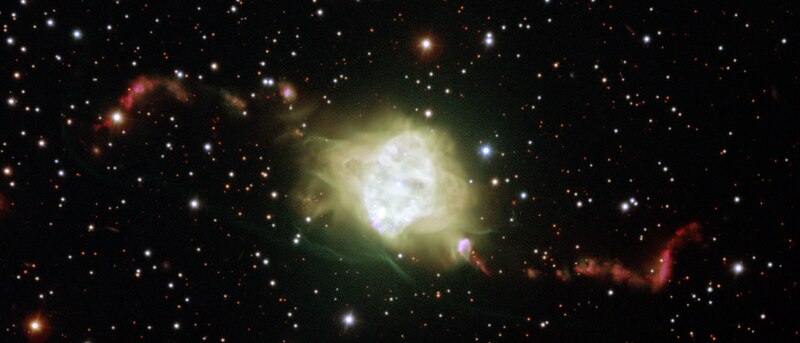
Dosya:The planetary nebula Fleming 1 seen with ESO’s Very Large Telescope.tiff
 | Bu dosya Wikimedia Commons'ta bulunmaktadır. Dosyanın açıklaması aşağıda gösterilmiştir. Commons, serbest/özgür telifli medya dosyalarının bulundurulduğu depodur. Siz de yardım edebilirsiniz. |


Özet
| Açıklama |
English: Cosmic Sprinklers Explained
Odd pair of aging stars sculpt spectacular shape of planetary nebula Astronomers using ESO’s Very Large Telescope have discovered a pair of stars orbiting each other at the centre of one of the most remarkable examples of a planetary nebula. The new result confirms a long-debated theory about what controls the spectacular and symmetric appearance of the material flung out into space. The results are published in the 9 November 2012 issue of the journal Science. Planetary nebulae [1] are glowing shells of gas around white dwarfs — Sun-like stars in the final stages of their lives. Fleming 1 is a beautiful example that has strikingly symmetric jets [2] that weave into knotty, curved patterns. It is located in the southern constellation of Centaurus (The Centaur) and was discovered just over a century ago by Williamina Fleming [3], a former maid who was hired by Harvard College Observatory after showing an aptitude for astronomy. Astronomers have long debated how these symmetric jets could be created, but no consensus has been reached. Now, a research team led by Henri Boffin (ESO, Chile) has combined new Very Large Telescope (VLT) observations of Fleming 1 with existing computer modelling to explain in detail for the first time how these bizarre shapes came about. The team used ESO’s VLT to study the light coming from the central star. They found that Fleming 1 is likely to have not one but two white dwarfs at its centre, circling each other every 1.2 days. Although binary stars have been found at the hearts of planetary nebulae before, systems with two white dwarfs orbiting each other are very rare [4]. “The origin of the beautiful and intricate shapes of Fleming 1 and similar objects has been controversial for many decades,” says Henri Boffin. “Astronomers have suggested a binary star before, but it was always thought that in this case the pair would be well separated, with an orbital period of tens of years or longer. Thanks to our models and observations, which let us examine this unusual system in great detail and peer right into the heart of the nebula, we found the pair to be several thousand times closer.” When a star with a mass up to eight times that of the Sun approaches the end of its life, it blows off its outer shells and begins to lose mass. This allows the hot, inner core of the star to radiate strongly, causing this outward-moving cocoon of gas to glow brightly as a planetary nebula. While stars are spherical, many of these planetary nebulae are strikingly complex, with knots, filaments, and intense jets of material forming intricate patterns. Some of the most spectacular nebulae — including Fleming 1 — present point-symmetric structures [5]. For this planetary nebula it means that the material appears to shoot from both poles of the central region in S-shaped flows. This new study shows that these patterns for Fleming 1 are the result of the close interaction between a pair of stars — the surprising swansong of a stellar couple. “This is the most comprehensive case yet of a binary central star for which simulations have correctly predicted how it shaped the surrounding nebula — and in a truly spectacular fashion,” explains co-author Brent Miszalski, from SAAO and SALT (South Africa). The pair of stars in the middle of this nebula is vital to explain its observed structure. As the stars aged, they expanded, and for part of this time, one acted as a stellar vampire, sucking material from its companion. This material then flowed in towards the vampire, encircling it with a disc known as an accretion disc [6]. As the two stars orbited one another, they both interacted with this disc and caused it to behave like a wobbling spinning top — a type of motion called precession. This movement affects the behaviour of any material that has been pushed outwards from the poles of the system, such as outflowing jets. This study now confirms that precessing accretion discs within binary systems cause the stunningly symmetric patterns around planetary nebulae like Fleming 1. The deep images from the VLT have also led to the discovery of a knotted ring of material within the inner nebula. Such a ring of material is also known to exist in other families of binary systems, and appears to be a telltale signature of the presence of a stellar couple. “Our results bring further confirmation of the role played by interaction between pairs of stars to shape, and perhaps even form, planetary nebulae,” concludes Boffin. Notes [1] Planetary nebulae have nothing to do with planets. The name arose in the eighteenth century as some of these objects resembled the discs of the distant planets when seen through small telescopes. [2] Jets are outflows of very fast-moving gas that are ejected from the core regions of planetary nebulae. They are often collimated — the material comes out in parallel streams — meaning that they spread out only very slightly as they propagate through space. [3] Fleming 1 is named after Scottish astronomer Williamina Fleming, who discovered it in 1910. Initially working as a maid to the director of the Harvard College Observatory in the 1880s, Fleming was later hired to process astronomical data at the observatory as one of the Harvard Computers, a group of skilled female workers carrying out mathematical calculations and clerical work. During her time she discovered — and was credited for — numerous astronomical objects, including 59 gaseous nebulae, over 310 variable stars, and 10 novae. This object also has many other names, including PN G290.5+07.9, ESO 170-6 and Hen 2-66. [4] The team studied the stars using the FORS instrument on the Very Large Telescope at ESO’s Paranal Observatory in Chile. As well as taking images of the object they also split the light up into its component colours to obtain information about the motions as well as the temperature and chemical composition of the central object. The primary and secondary stars were found to have approximately 0.5 to 0.86 and 0.7 to 1.0 times the mass of the Sun, respectively. The team was able to rule out the possibility of there being a “normal” star like our Sun in the binary by analysing the light from the two stars, and studying the system’s brightness. As the system rotates its brightness only changes by tiny amounts. A normal star would have been heated by its hot white dwarf, and because it would be always presenting the same face to its companion (as the Moon does with the Earth), it would present a “hot and luminous” and “cold and dark” side, easily seen as a regular variation in brightness. The central object is thus very likely a pair of white dwarfs — a rare and exotic find. [5] In this case each part of the nebula has an exact counterpart at the same distance from the star, but in the opposite direction — the kind of symmetry shown by the court cards in a conventional pack of playing cards. [6] Such a disc is formed when the stream of material escaping from a star overflows a certain boundary, known as the Roche lobe. Within this lobe, all matter is bound to its host star by gravity and cannot escape. When this lobe fills up and the boundary is exceeded, mass tumbles away from the star and transfers to a nearby body, for example the second star in a binary system, forming an accretion disc. More information This research was presented in a paper “An Interacting Binary System Powers Precessing Outflows of an Evolved Star”, H. M. J. Boffin et al., to appear in the journal Science on 9 November 2012. The team is composed of H. M. J. Boffin (European Southern Observatory, Chile), B. Miszalski (South African Astronomical Observatory; Southern African Large Telescope Foundation, South Africa), T. Rauch (Institute for Astronomy and Astrophysics, University of Tübingen, Germany), D. Jones (European Southern Observatory, Chile), R. L. M. Corradi (Instituto de Astrofísica de Canarias; Departamento de Astrofísica, Universidad de La Laguna, Spain), R. Napiwotzki (University of Hertfordshire, United Kingdom), A. C. Day-Jones (Universidad de Chile, Chile), and J. Köppen (Observatoire de Strasbourg, France). To obtain a copy of the Science paper please contact the Science Press Package office at either scipak@aaas.org (email), or +1 202 326 6440 (phone). The year 2012 marks the 50th anniversary of the founding of the European Southern Observatory (ESO). ESO is the foremost intergovernmental astronomy organisation in Europe and the world’s most productive ground-based astronomical observatory by far. It is supported by 15 countries: Austria, Belgium, Brazil, the Czech Republic, Denmark, France, Finland, Germany, Italy, the Netherlands, Portugal, Spain, Sweden, Switzerland and the United Kingdom. ESO carries out an ambitious programme focused on the design, construction and operation of powerful ground-based observing facilities enabling astronomers to make important scientific discoveries. ESO also plays a leading role in promoting and organising cooperation in astronomical research. ESO operates three unique world-class observing sites in Chile: La Silla, Paranal and Chajnantor. At Paranal, ESO operates the Very Large Telescope, the world’s most advanced visible-light astronomical observatory and two survey telescopes. VISTA works in the infrared and is the world’s largest survey telescope and the VLT Survey Telescope is the largest telescope designed to exclusively survey the skies in visible light. ESO is the European partner of a revolutionary astronomical telescope ALMA, the largest astronomical project in existence. ESO is currently planning the 39-metre European Extremely Large optical/near-infrared Telescope, the E-ELT, which will become “the world’s biggest eye on the sky”. Credit: ESO About the Image Id: eso1244a Type: Observation Release date: 8 November 2012, 20:00 Related releases: eso1244 Size: 1382 x 592 px About the Object Name: Fleming 1, PN G290.5+07.9 Type: • Milky Way : Nebula : Type : Planetary • Nebulae Distance: 10000 light years Colours & filters Band Wavelength Telescope Optical H-alpha + [NII] 660 nm Very Large Telescope FORS2 Optical [OIII] 504 nm Very Large Telescope FORS2 Optical [OII] 378 nm Very Large Telescope FORS2. |
| Tarih | |
| Kaynak | http://www.eso.org/public/news/eso1244/ Direct link |
| Yazar | European Southern Astronomy (ESO) |
| İzin (Bu dosyanın tekrar kullanımı) |
http://www.eso.org/public/outreach/copyright.html |
Lisanslama
_logo.svg) |
This media was created by the European Southern Observatory (ESO).
Their website states: "Unless specifically noted, the images, videos, and music distributed on the public ESO website, along with the texts of press releases, announcements, pictures of the week, blog posts and captions, are licensed under a Creative Commons Attribution 4.0 International License, and may on a non-exclusive basis be reproduced without fee provided the credit is clear and visible." To the uploader: You must provide a link (URL) to the original file and the authorship information if available. |
  Bu dosya Creative Commons Atıf 4.0 Uluslararası lisansı altında lisanslanmıştır.
| |
Dosya geçmişi
Dosyanın herhangi bir zamandaki hâli için ilgili tarih/saat kısmına tıklayın.
| Tarih/Saat | Küçük resim | Boyutlar | Kullanıcı | Yorum | |
|---|---|---|---|---|---|
| güncel | 13.40, 11 Kasım 2012 |  | 1.382 × 592 (1,75 MB) | Fabian RRRR | =={{int:filedesc}}== {{Information |description={{en|1='''Cosmic Sprinklers Explained''' Odd pair of aging stars sculpt spectacular shape of planetary nebula Astronomers using ESO’s Very Large Telescope have discovered a pair of stars orbiting each... |
Dosya kullanımı
Bu görüntü dosyasına bağlantısı olan sayfalar:
Küresel dosya kullanımı
Aşağıdaki diğer vikiler bu dosyayı kullanmaktadır:
- af.wikipedia.org üzerinde kullanımı
- ar.wikipedia.org üzerinde kullanımı
- de.wikipedia.org üzerinde kullanımı
- en.wikipedia.org üzerinde kullanımı
- fr.wikipedia.org üzerinde kullanımı
- hy.wikipedia.org üzerinde kullanımı
- it.wikipedia.org üzerinde kullanımı
- ja.wikipedia.org üzerinde kullanımı
- ko.wikipedia.org üzerinde kullanımı
- mk.wikipedia.org üzerinde kullanımı
- nl.wikipedia.org üzerinde kullanımı
- ru.wikipedia.org üzerinde kullanımı
- si.wikipedia.org üzerinde kullanımı
- uk.wikipedia.org üzerinde kullanımı
- vi.wikipedia.org üzerinde kullanımı
- www.wikidata.org üzerinde kullanımı
- zh.wikipedia.org üzerinde kullanımı